How to use this
Nick is not valuable because he inspires people despite having a disability. He is valuable because he is a person.
His experiences then give students an opportunity to discuss resilience, identity, agency, inclusion and purpose.
The film is a case study, not a sermon. Students may hold religious beliefs, non-religious beliefs or different philosophies entirely. The guide works from the universally accessible lessons in a lived experience.
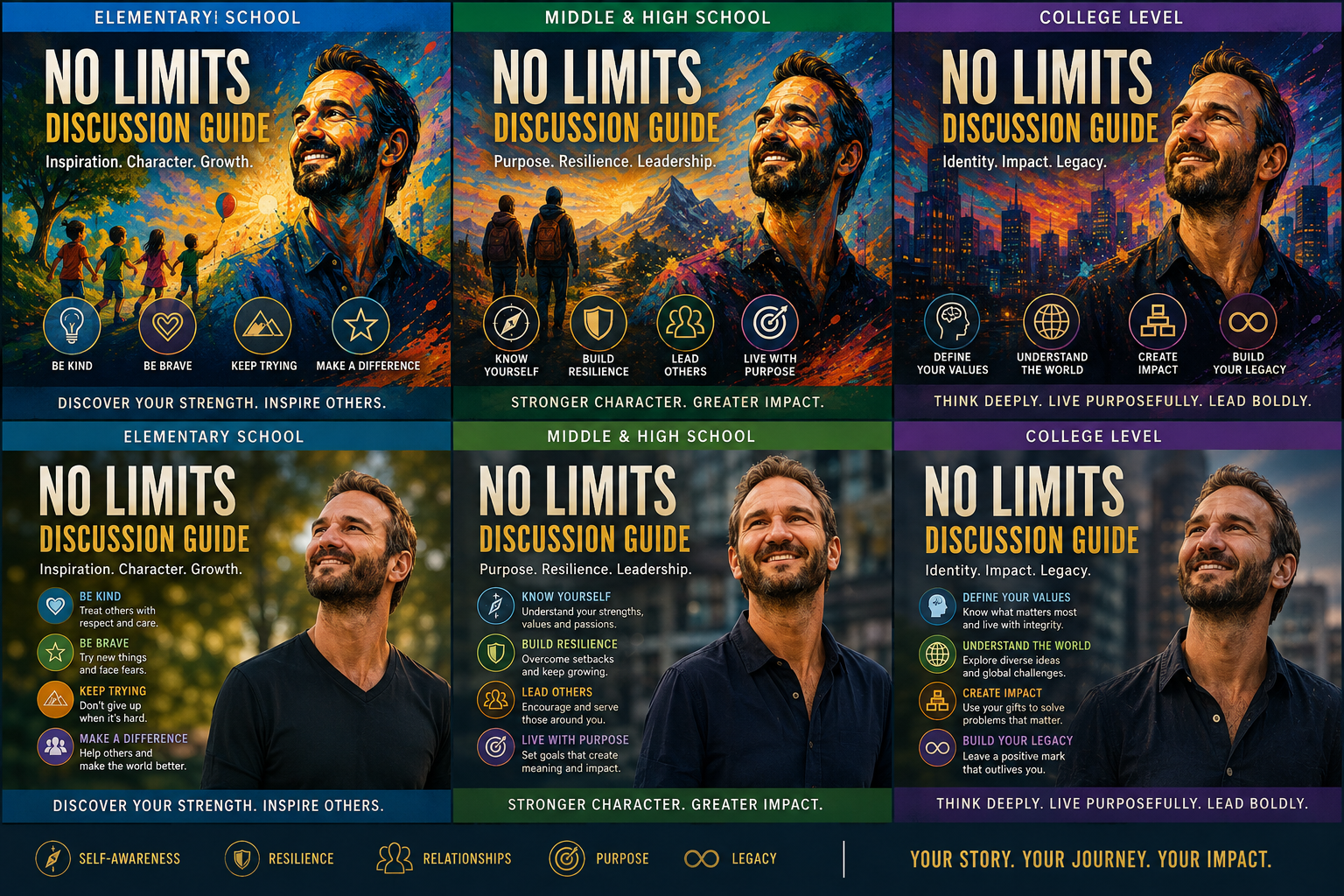
Elementary
Inspiration. Character. Growth.
Grades 3 to 5
Concrete, optimistic and emotionally safe. Disability is never framed as the thing that makes Nick valuable because he overcame it. Every person has value before achievement, and people solve problems in different ways.
- Be kind
- Be brave
- Keep trying
- Make a difference
Lesson One Self-Management
When Life Feels Hard
We cannot control everything that happens, but we can learn how to respond.
Disappointment, frustration and sadness are normal. A hard situation does not mean the day, the goal or the person is ruined. Students practise separating what they can control from what they cannot.
Discussion
- What is something that has not gone the way you hoped, and how did you feel?
- Which parts of that could you control? Which parts could you not?
- Who can you ask for help, and what is one small next step?
- Is changing your plan the same as giving up?
- Why can patience sometimes be a strength?
ActivityDraw two circles, “I can control” and “I cannot control”, and place examples in each.
I may not choose every challenge. I can choose my next step.
Lesson Two Self-Awareness
I Am More Than One Thing
A person is never defined by one characteristic, ability, mistake or label.
Identity is a combination of personality, interests, relationships, skills, values, experiences and dreams. A disability is one part of a person, not the whole person, and grades, sport, appearance and popularity do not decide anyone's worth.
Discussion
- What are five words that describe you besides what you look like?
- How would you feel if people noticed only one thing about you?
- Can someone need help and still be strong?
- What qualities in Nick have nothing to do with his body?
- How can a class make sure everyone belongs?
ActivityBuild an “I am more than…” identity wheel.
One thing about me is never all of me.
Lesson Three Self-Management
Challenges Can Teach Us
Difficult experiences are not automatically good, but we can learn skills through them.
Problems can build creativity, patience, flexibility and empathy. We never make fun of someone's struggle or tell them they should be grateful for it. We ask what can help, and what can be learned.
Discussion
- What is the difference between a problem and a person?
- What skill have you learned because something was difficult?
- Why might two people solve the same problem differently?
- When should you keep trying, and when should you try a different way?
- Why is asking for help a skill?
ActivityTeams get one simple problem and must find three different solutions.
A challenge can become a classroom.
Lesson Four Responsible Decision-Making
Be Brave Before You Know
Courage means taking a thoughtful next step even when we do not know what will happen.
Courage is not the absence of fear. We can prepare, ask questions, get support, and act according to what matters to us.
Discussion
- Can a brave person still feel afraid?
- What is the difference between courage and recklessness?
- How can preparation make us braver?
- What happens if your first attempt does not work?
- What brave step could you take this week?
ActivityCourage ladder: write one small, one medium and one bigger step toward a goal.
I do not need to know the ending before I begin.
Lesson Five Relationship Skills
Your Story Can Help Someone
Experiences become meaningful when we use what we learn to encourage others.
Sharing is not bragging. A useful story says what happened, what was learned, and how it might help someone else.
Discussion
- What makes a story helpful instead of boastful?
- Why should we ask permission before sharing someone else's story?
- What can we learn from Nick without pretending our lives are the same?
- When is listening more useful than giving advice?
- Who could you encourage this week?
ActivityComplete the sentence: “I learned ___, and it might help someone because ___.”
What I learn can become something I give.
Lesson Six Social Awareness
Care Becomes Action
Empathy matters most when it changes how we treat people.
Notice who is left out. Listen before assuming. Include people. Help without taking over. Speak up respectfully.
Discussion
- What is the difference between feeling sorry for someone and understanding them?
- How can we help without making someone feel helpless?
- What does inclusion look like at break or in class?
- What could your class change so everyone can join in?
- What will you personally do?
ActivityWrite a class pledge: notice, listen, include, help.
Kindness becomes powerful when it becomes action.
Middle and High School
Purpose. Resilience. Leadership.
Grades 6 to 12
Old enough to name comparison, social media, bullying, belonging, pressure, setbacks and self-image directly. Facilitator flexibility for maturity level.
- Know yourself
- Build resilience
- Lead others
- Live with purpose
Lesson One Self-Management
When Life Doesn't Go as Planned
Resilience is not pretending disappointment does not hurt.
It is acknowledging reality, processing the emotion, and deciding what remains possible. Students learn the difference between acceptance and resignation. Acceptance says this is real. Agency asks what I can do next.
Discussion
- Why do people sometimes believe a good life should be free of hardship?
- What is the difference between acceptance and giving up?
- Which parts of a setback deserve to be grieved, and which require action?
- When does persistence become unproductive?
- How does Nick's story challenge the idea that a meaningful life needs ideal circumstances?
ActivityControl, influence, accept. Sort a real setback into the three columns.
Resilience begins with reality, not denial.
Lesson Two Self-Awareness
Identity Beyond Labels
Identity is larger than appearance, achievement, disability, popularity or other people's expectations.
Labels may describe something true without defining the whole person. Comparison distorts self-perception, and human worth should not be ranked by productivity, appearance or status.
Discussion
- When is a label useful, and when does it become limiting?
- How does social media intensify comparison?
- What happens when achievement becomes identity?
- How do disability stereotypes affect how people are treated?
- What would it mean to see Nick as a complete person rather than an inspirational disability story?
ActivityTwo columns: labels others give me, and qualities I choose to develop.
Your circumstances influence your story. They do not own your identity.
Lesson Three Self-Management
Turn Challenge into Capacity
Hard experiences can develop skill, insight and empathy, but hardship should never be romanticised.
Vulnerability and strength coexist. Adaptation is intelligence in action, and a limitation in one area can force invention in another.
Discussion
- Why is it harmful to say every bad thing happens for a reason?
- Can asking for help demonstrate maturity?
- What accommodations let people show ability rather than be blocked by unnecessary barriers?
- How has Nick adapted rather than simply overcome?
- How could a challenge in your life become useful knowledge?
ActivityTeams redesign an everyday space on site to make it more accessible.
Strength is often the ability to adapt, not the ability to pretend nothing is hard.
Lesson Four Responsible Decision-Making
Courage Without Certainty
Mature decisions get made before outcomes are guaranteed.
Students separate hope from prediction, courage from impulsiveness, and values-based action from outcome-based self-worth.
Discussion
- Can a good decision still produce a disappointing result?
- What makes a risk thoughtful rather than reckless?
- What values guide a decision when the outcome is unknown?
- How should you judge yourself after a result you could not control?
- What worthwhile decision may you need to make without a guarantee?
ActivityDecision grid: values, risks, resources, next step.
A strong decision is measured by the process, not only the result.
Lesson Five Relationship Skills
From Story to Impact
Personal experience creates positive influence when it is shared responsibly.
Storytelling carries an ethical duty. It should not exaggerate, exploit others, or turn pain into performance. The best personal stories connect experience to useful insight.
Discussion
- What is the difference between influence and attention?
- When does storytelling become self-promotion?
- What responsibilities come with telling someone else's story?
- Why should people avoid comparing suffering?
- How can you share a lesson without making yourself the centre of everything?
ActivityWrite a ninety second story: experience, lesson, contribution.
Your story becomes powerful when it creates value for someone else.
Lesson Six Social Awareness
Empathy into Action
Inspiration that never changes behaviour has limited value.
Empathy should shape how we include, design, communicate, lead and advocate. Students move from awareness to measurable behaviour.
Discussion
- What is performative kindness?
- How do schools unintentionally exclude people?
- What barriers exist even when nobody intends harm?
- How can students challenge a stereotype without embarrassing anyone?
- What action will you personally take within seven days?
ActivitySmall groups design a seven day inclusion action with a named outcome.
Awareness changes us only when it changes what we do.
College and University
Identity. Impact. Legacy.
Undergraduate and above
Less a youth worksheet, more a seminar in resilience, identity, leadership, disability inclusion, narrative ethics and purpose.
- Define your values
- Understand the world
- Create impact
- Build your legacy
Lesson One Self-Management
Adversity Without Easy Answers
Mature resilience does not require a simple explanation for suffering.
People search for explanations when life violates expectation. What resilience actually requires is the capacity to face reality, tolerate ambiguity, mobilise resources and keep making meaningful choices.
Discussion
- Why are people uncomfortable with unresolved suffering?
- What separates meaning-making from inventing a convenient explanation?
- When can perseverance become unhealthy?
- What role does grief play in adaptation?
- How does Nick's life complicate simplistic overcoming-adversity narratives?
ActivityAnalyse a real setback through reality, interpretation, agency, support, next action.
I can acknowledge what I cannot change without surrendering what I can still choose.
Lesson Two Self-Awareness
Identity, Dignity and the Limits of Labels
No single label should be allowed to erase the complexity of a person.
Identity includes embodied experience, social context, relationships, values, roles and self-authorship. Institutions assign value to people, and productivity gets confused with worth.
Discussion
- When are identity labels empowering, and when do they become reductive?
- How does disability challenge assumptions about independence and competence?
- What does ableism look like in ordinary systems rather than deliberate prejudice?
- What is the difference between independence and autonomy?
- Which parts of your identity have been overemphasised by other people?
ActivityIdentity architecture: inherited labels, chosen values, roles, strengths, relationships, future commitments.
Description is not destiny.
Lesson Three Social Awareness
Vulnerability as Capacity
Vulnerability is not automatically weakness, and nobody owes the world productivity in exchange for their suffering.
It can increase self-awareness, trust, creativity, cooperation and adaptive leadership. At the same time, no one should have to convert pain into output for that pain to count.
Discussion
- Why do high-performance cultures hide vulnerability?
- What is the social model of disability distinguishing between impairment and environment?
- Why is inspiration sometimes an uncomfortable frame for disabled people?
- What ethical risk arises when an audience celebrates someone mainly for functioning with a disability?
- How can leaders build environments where people need not hide limitations?
ActivityRedesign a campus experience through an accessibility and dignity lens.
Capacity grows when people can adapt rather than imitate one definition of ability.
Lesson Four Responsible Decision-Making
Agency Under Uncertainty
Adult life is full of decisions made without complete information.
Responsible agency combines values, evidence, preparation, risk assessment, and a willingness to act without guarantees.
Discussion
- What distinguishes uncertainty from ignorance?
- Can a decision be sound even when its outcome is poor?
- How do values function when the evidence is incomplete?
- When is waiting rational, and when is it avoidance?
- Which unresolved decision of yours needs a better process rather than a better prediction?
ActivityDecision-under-uncertainty case analysis.
Judge decisions by integrity, evidence and process, not by outcomes alone.
Lesson Five Relationship Skills
Narrative, Influence and Responsibility
Storytelling can educate and mobilise. It can also commodify pain and flatten a complicated life into a cliche.
Narrative persuades more strongly than data, which is exactly why it carries obligations.
Discussion
- What ethical obligations accompany autobiographical storytelling?
- When does vulnerability become branding?
- What is inspiration porn, and why do disability advocates critique it?
- How can an audience receive Nick's story without treating him as extraordinary merely for existing with a disability?
- What story are you responsible for telling carefully?
ActivityEvaluate a public personal story for accuracy, agency, dignity, audience and impact.
Influence carries responsibility.
Lesson Six Social Awareness
From Insight to Contribution
Reflection becomes meaningful when it turns into conduct, leadership and contribution.
Inspiration is temporary. Habit is not. And the people affected by a problem should help define the solutions intended for them.
Discussion
- What turns reflection into habit?
- What is the difference between helping and paternalism?
- How can accessibility improve an environment for people beyond the intended group?
- How should impact be measured?
- What specific action will you take because of this discussion?
ActivityDesign a thirty day contribution project with a measurable outcome.
Insight becomes leadership when it changes behaviour.